

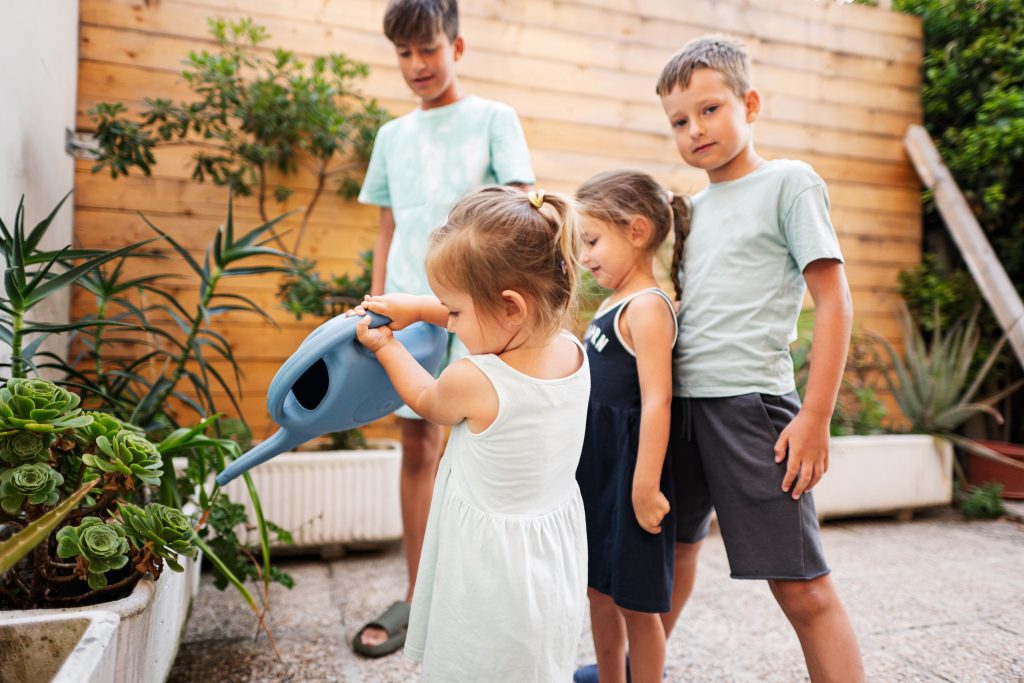
A practical method for housing groups: ask a focused question, protect participants and show how their observations affect the work.
Children can explain how a neighborhood works at the scale of a school journey, a crossing, a play area or an apartment courtyard. To use that knowledge well, a housing or neighborhood project needs a clear question, an age-appropriate way to participate and a plan to show children what happened to their suggestions.
Ask about a real decision
Choose something the project can influence. For example, a courtyard improvement group might ask where children wait for friends, where they find shade and which routes feel difficult to use. Explain the area under discussion and any limits on the work.
Avoid asking children to redesign an entire neighborhood if the available decision concerns one entrance or shared space. A focused question makes it easier to connect their observations to a drawing, maintenance task or budget request.
Design an activity around a decision children can understand
Suppose a housing group is considering changes to a shared courtyard. This is an illustrative planning exercise. Begin by showing the space and explaining which choices are open, such as the location of seating or an activity area. Explain any fixed boundaries without asking children to solve technical or budget problems.
Give participants a simple task: identify a place they use, a place they avoid and something that would make the space easier to use. Allow drawing, conversation or another accessible method. The activity should make room for different ages and communication needs.
Adults should distinguish a child’s observation from their own interpretation. A child saying that a gate is difficult to open has identified an experience. The reason may require inspection. Record the observation accurately before deciding on a remedy.
End the activity by explaining what happens next, who will review the suggestions and how children will hear back. A named next step helps participation feel connected to a real decision. Do not promise that every suggestion will be built.
Offer more than one way to contribute
Younger children may prefer drawing a familiar route or marking places on a simple map. Older children may want to discuss travel times, seating or access after school. Provide alternatives for children who cannot comfortably draw, speak in a group or join a walk.
A supervised visit can help participants identify details that an indoor meeting misses. Obtain appropriate parent or guardian permission, plan accessibility and supervision, and avoid collecting or publishing children’s home addresses or identifiable travel routines.
UNICEF’s Child Friendly Cities Initiative guidance places children’s views and rights within local decision-making. It provides a broader framework for meaningful participation. Holding a workshop does not itself make a place a UNICEF-recognized Child Friendly City.
Invite children whose experiences are easy to miss
Work with trusted local organizations to reach participants beyond the families who already attend meetings. Consider language, disability, meeting times and the cost of getting there. Explain participation in a way families can understand before they agree.
Ask about different experiences without requiring a child to disclose personal hardship. A question such as where it is difficult to cross the street is more appropriate than asking a child to explain their family’s finances or housing insecurity.
Make participation safe and fair
Choose a setting where children can contribute without being pressured to agree with adults or other participants. Explain that participation is voluntary and that someone can stop or decline a question. Use suitable safeguarding arrangements through the organization responsible for the activity.
Plan how photographs, drawings and quotations will be used before collecting them. Obtain the appropriate permissions and avoid including names, addresses or identifiable routines in a public record without a justified, agreed purpose. A planning exercise usually does not need that information.
Think about who cannot join the proposed activity. A walking session may exclude a child with particular mobility or sensory needs. A single after-school time may conflict with care arrangements. Offer a workable alternative that addresses the same question.
Do not ask one participant to speak for all children or for everyone with a particular disability. Describe the group that actually contributed and acknowledge the experiences still missing. That keeps the findings accurate and helps the next round of participation reach other residents.
Turn observations into an accountable record
Separate what children observed from the adults’ proposed response. A simple record can use four columns: place, concern, suggested action and person responsible for checking it. Keep identifying information out of the public version.
For example, a child may report that a courtyard gate is difficult to open. The project team can inspect it, check access and safety requirements, and explain the repair decision. This example illustrates the planning process.
Show how observations change the proposal
Create a decision record with four parts: the concern, the proposed response, the person checking it and the outcome. For the courtyard gate example, the response might begin with an access and safety inspection. The final decision should explain what was found and what work is feasible.
Present the revised proposal in a form participants can understand. Use a simple plan or photographs where permissions allow, and explain which suggestions changed the design. For a rejected suggestion, give the actual reason and identify any alternative being considered.
After the work is complete, invite feedback on use. A changed gate may still be difficult for a particular resident, or the path leading to it may present another obstacle. The follow-up should focus on the original experience and should examine use after installation.
This approach links education, participation and housing management. Children learn how a local decision is made, while the organization receives information about the space. The value depends on the quality of the response as well as the opportunity to speak.
Return with an explanation
Arrange a follow-up in a format the participants can use. Show which suggestions were accepted, which require more work and which cannot proceed. Explain the reasons in plain language and identify any next decision date.
After a change is completed, ask whether it helped. If an entrance is easier to use but a new obstacle remains, record that observation too. Participation should influence the work and its evaluation.
For related ways adults and children can help identify local priorities, read five neighborhood projects residents can organize. N4SF’s commitment to education and sustainable communities provides a relevant foundation for this work.